
Aquatecture 1: Potential of Water Architecture
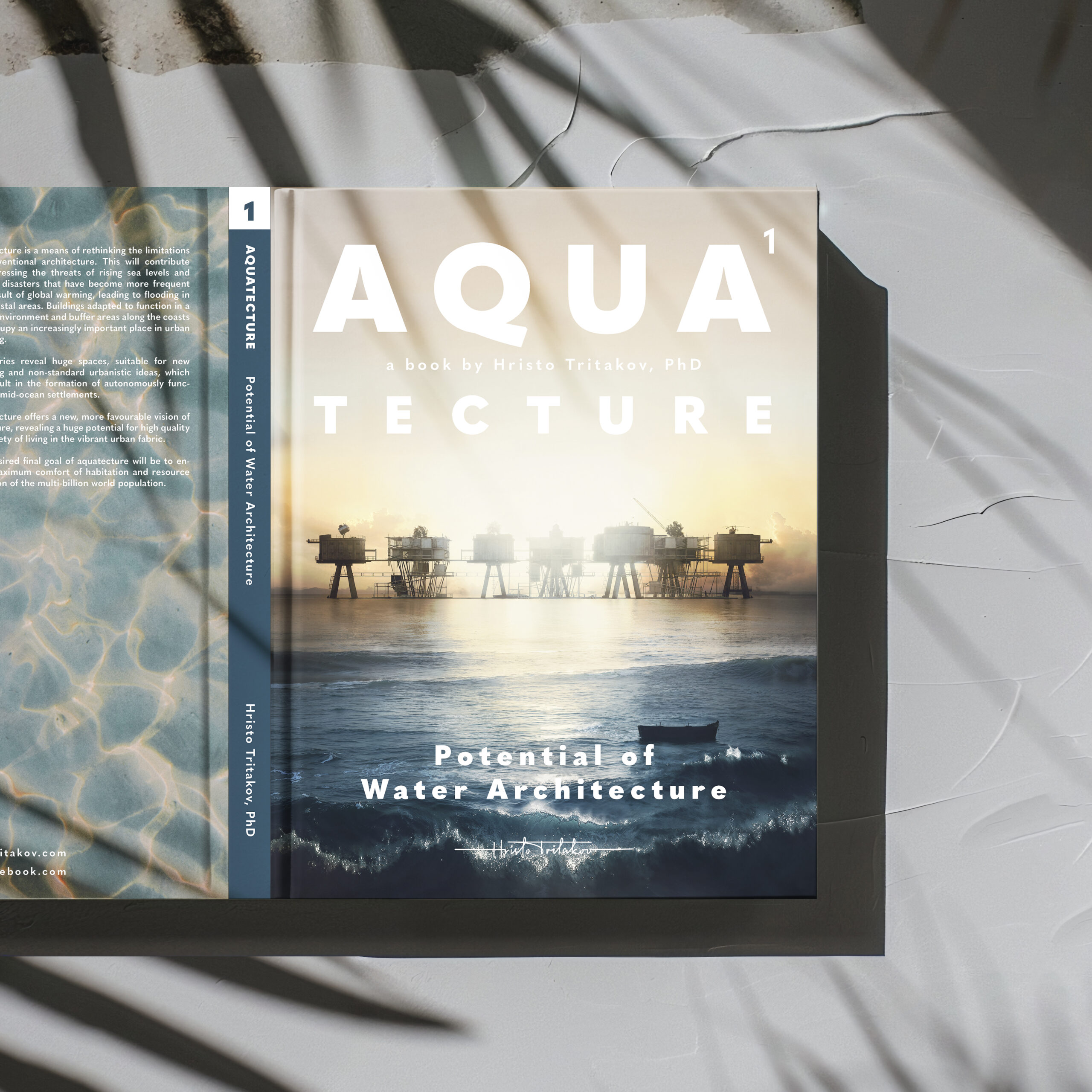
Aquatecture 1: Potential of Water Architecture is the first volume of the Aquatecture book series by Bulgarian architect Hristo Tritakov, PhD. It examines how architecture located wholly or partly in water – aquatecture – can help coastal cities grow more compact, safer and better prepared for global warming and sea-level rise. The book is available worldwide on Amazon in colour and black-and-white editions.
About the book
The aquatory has the potential to accommodate a vast number of new urban residential and public functions, which would enable the city to become considerably more compact. This type of planning will ensure a more favourable living environment, provided that the qualities of the aquatic areas are not harmed and that these territories are optimally incorporated into the urban fabric.
Aquatecture provides solutions to the problems associated with global warming and rising sea levels. Coastal areas should be adapted so that cities can function effectively and keep their residents safe, even in the case of floods or other water-related natural disasters.
Relevance of the research
Contemporary architecture is a dynamically developing system which, despite its multi-layered and rapid development under globalisation, fails to meet today’s high societal standards for living. Human security, overpopulation, overconstruction, the growing number of natural disasters and the careless use of the Earth’s water and energy resources remain unsolved – and even tend to deepen with time.
A vision of the future in which architecture in an aquatic environment is an integral part of human life – at both urban and local planning levels – would be of great benefit to society. People’s affinity to water, the location of key urban centres near large bodies of water, innovations in construction and industrial and scientific developments all favour architectural answers that offer a high quality of life and the optimal use of aquatic environments.
The static nature of conventional architecture and the lack of space on the mainland are the main problems of almost every large city in the world. Water architecture is a significant alternative to today’s limited opportunities for building on land. Designing in this context has long outgrown utopian cities and naive visions of future urban planning. Although conceptual designs still outnumber realisations, the experience of the Netherlands and of many water settlements worldwide proves that the benefits of this type of design are essential for architectural practice – and should be analysed to support a wider application of aquatecture around the world.
A global paradox
Life on water is typical both of poor social groups – such as the marine settlements of Africa and Northeast Asia – and of people with luxurious, extravagant lifestyles, as in Dubai and the Maldives, regions of high-end tourism on the water. Such social differences should be overcome as humanity develops in the 21st century.
The key to aquatic architecture should be its accessibility to all social classes. Its primary focus should be the optimal use of marine areas, a better quality of life and greater safety against natural disasters in water settlements.
Questions the book explores
- Can aquatic architecture become a global phenomenon?
- Can living on water reach the comfort of building on land with a similar construction budget?
- To what extent would extending cities into the surrounding aquatory enrich, improve or compromise urban development on the coast?
- Should we look for a new archetype, new materials and new technologies that make marine projects a logical, harmonious part of their surroundings?
- What are the future scenarios for the mass use of aquatecture worldwide?
Get the book
- Aquatecture 1: Potential of Water Architecture – colour edition on Amazon
- Aquatecture 1 – black-and-white edition on Amazon
- More about the series: aquatecturethebook.com
The Aquatecture book series
- Aquatecture 1: Potential of Water Architecture (this volume)
- Aquatecture 2: Perspectives of Water Architecture
- Aquatecture 3: In Search of New Form and Function – forthcoming
- Aquatecture 4: Prototypes of Water Settlements – forthcoming
The series builds on the doctoral research Aquatecture: Potential of Architecture in Water Environment (UACEG, Sofia). A bilingual Bulgarian–English edition, Акватектура. Aquatecture, is also available. See all books and papers on the Publications page.