
Origami – a Modular System of Floating Houses
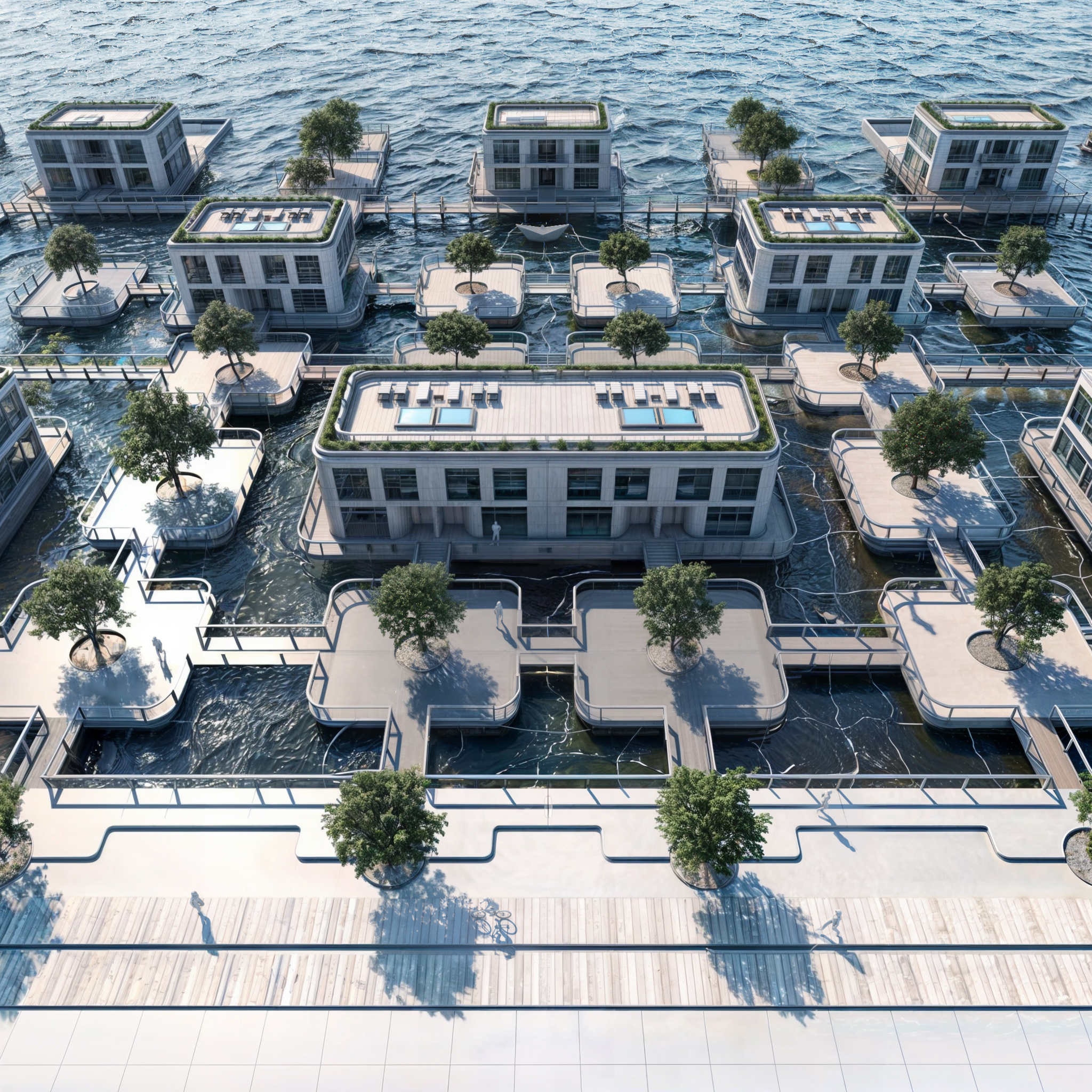
The Japanese art of origami turns a single sheet of paper into countless shapes. Origami, a project by Mess is More, applies the same principle to life on the water: a family of floating buildings derived from one modular logic, which can stand alone in the aquatory or be combined into whole floating districts.
Designing the module
Before any layout was drawn, the design tested what a floating building really needs: proportions and number of storeys matched to the size of the pontoon base; a compact footprint that still feels comfortable to live in; access and orientation that work in any direction; affordable materials that resist the water; and a recognisable language of rounded corners, a standard suspended façade and integrated greenery. Façade treatment then distinguishes homes from public and office buildings.
One system, three uses
- Homes – from a single-family house with four bedrooms (type A) to semi-detached and terraced buildings for two, four or eight families (types B, B+ and B++).
- Hotels – floating units of rooms and suites in three sizes (H, H+, H++), grouped around a public module with a restaurant, bar, kitchen and services (type P).
- Offices – two- and three-storey office buildings (O and O+) with open-plan or divided layouts.
Four ways to build on the water
The modules are tested in four urban scenarios: a compact residential quarter close to the shore with generous greenery; a luxury neighbourhood among tall trees and recreation spaces; a cluster of six floating offices with roof gardens for staff; and a hotel complex placed further out in the water for privacy and closeness to nature. Each can keep growing as new modules are added, and connect to buildings on the shore.
The system suits calm waters, and single modules could also be used in canals and harbours. In Bulgaria, floating buildings are currently registered as vessels after approval by a hydro-engineer – and the studio has already taken part in designing a floating container house built by Home Afloat, which sailed in Varna. More on the wider idea of water urbanism is in the book Aquatecture.
Recognition and press
- Archinova 2022 – Nominee, Hotels, holiday villages, attractions and spa centres
- CityBuild – Bulgarian studio develops ORIGAMI floating houses (November 2022)
- The Building – Origami, a modular system for water urbanism
See all coverage on the Media & Press page.